Let’s talk about stocks. No, not the Wall Street varieties, the flavorful liquid ones. We’re talking rich food, not rich brokerage accounts. Truthfully this probably should have been my first post, but I got carried away with other things.
Stocks are the backbone of amazing meals. They are the potion of the kitchen used to give dishes a depth of flavor you have only ever dreamed of. Stock is the foundation everything else builds on.
The thing is stocks are not an exact science. There is not some magical recipe for chicken, beef, or vegetable stock. Sure there are recipes out there, but the origin of stock comes from a simple desire to not waste anything.
Archaeological evidence suggests that as soon as humans had pottery that could hold water, controlled fire, and animal bones they were simmering those bones. It started as survival. There was still nutrition and calories locked inside them and people were not about to let that go to waste.
Fast forward to medieval times and this magical bone water became the basis for stews, pottages, and sauces. Large cauldrons simmered constantly over hearth fires and bones were often reused again and again.
Then came the French. Between the 17th and 19th centuries, in their relentless desire to organize and refine everything in the kitchen, they codified the way we make stocks. They formalized techniques like gentle simmering, never boiling the stock, skimming impurities as they rise, and clarifying. They also began distinguishing between stock, broth, and soup.
Stock is an unseasoned liquid made primarily from bones and used as a cooking foundation, while broth is a seasoned liquid meant to be eaten on its own.
By the early 1900s, thanks to chefs like Marie-Antoine Carême and Auguste Escoffier, stock had become the backbone of haute cuisine.
Of course the French and Western cuisine do not have a monopoly on flavorful bone potions. Simmered bone broths exist all over the world. The French may have standardized stock, but they certainly did not invent the idea.
In Vietnam, beef bones simmer for hours to create the deeply aromatic broth for pho.
In Japan, pork bones are boiled down into the rich cloudy base for tonkotsu ramen.
In Italy, brodo quietly supports soups and risotto.
In Mexico, caldo built on chicken or beef bones feeds entire families.
Different ingredients. Different traditions. But the same instinct. Take bones, water, and time and turn them into something greater than the sum of their parts.
As I mentioned earlier, stock is not an exact science. There is a time and place for strict recipes if you want perfect consistency every time, but this is not one of those moments.
I do not have a precise recipe for you. Just some guidelines. Whenever I am breaking down a whole chicken or trimming chicken wings, I make stock.
Roasted Chicken Stock
Ingredients
Leftover chicken carcass, bones, wing tips, or any roasted chicken scraps you have
1 large onion, large diced
1 to 2 large carrots, large diced (optional)
1 to 2 stalks of celery, large diced (optional)
33g tomato Paste
Cold water
Stock is forgiving. If you don’t have carrots or celery, that’s fine. Onion alone will still make a good pot of stock.
Instructions
- Gather whatever chicken bones you have from a roasted chicken. Carcass, backs, wing tips, and leftover bones all work well. If you don’t have enough bones yet, keep a bag in the freezer and add to it until you do.
- Rub the bones lightly with tomato paste and place them on a roasting tray with the diced onion, carrots, and celery.
- Roast at 400°F until everything is deeply browned. The vegetables should have color and the bones should look roasted and fragrant. The amount of vegetables depends on the amount of bones you have, so adjust as needed.
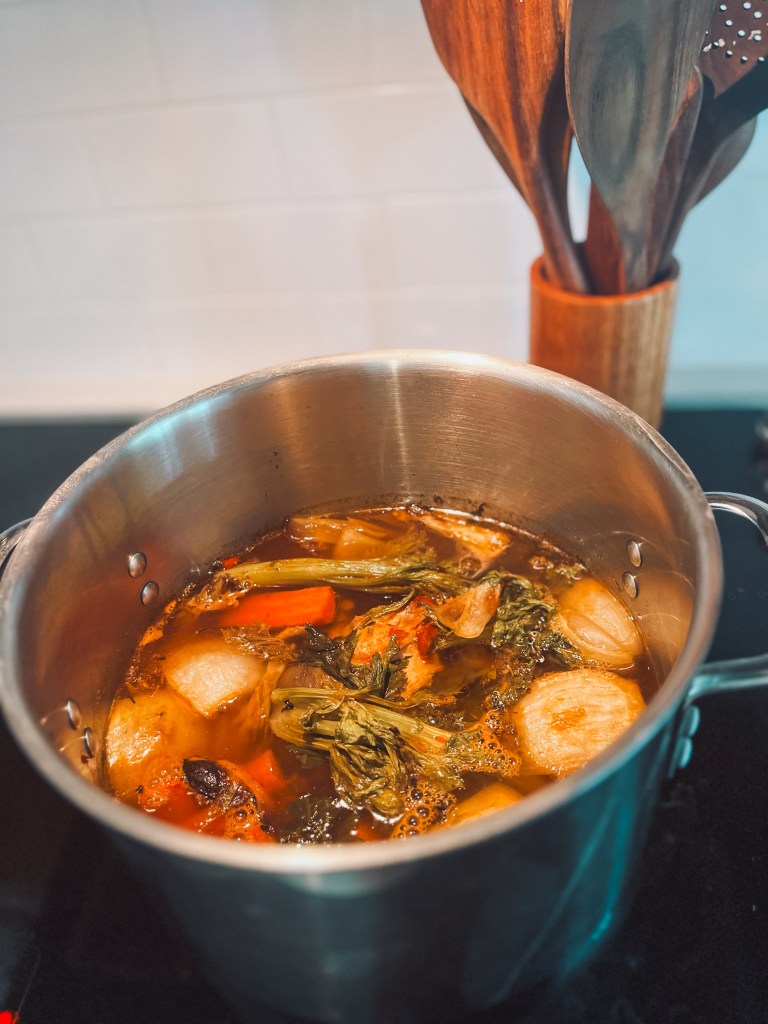
- Transfer the roasted bones and vegetables to a large pot. Add just enough cold water to cover everything.
- Bring the pot up slowly to a gentle simmer over medium heat. Keep the heat low. You want an occasional bubble, not a rolling boil.
- As the stock heats, foam and impurities will rise to the surface. Skim them off with a spoon and discard.
- Let the stock simmer until it reaches the flavor intensity you want, usually 3 to 4 hours on the stovetop.
- Taste the stock near the end. It should taste like rich chicken, not watery.
- Strain the liquid from the bones and vegetables and discard the solids.
Chef’s Notes
• Don’t salt your stock. Stock is meant to be reduced and used in other dishes. Salt the final dish instead.
• Freeze your bones. After roasting a chicken, toss the carcass and any scraps into a freezer bag. Once you have a few saved up, you’re ready for a pot of stock.
Storage
Stock freezes beautifully. I like to pour mine into gallon freezer bags and freeze them flat on a baking tray so they stack neatly in the chest freezer.
Good food often starts with something humble. A pile of bones, a pot of water, and patience.
 Meals with Mills