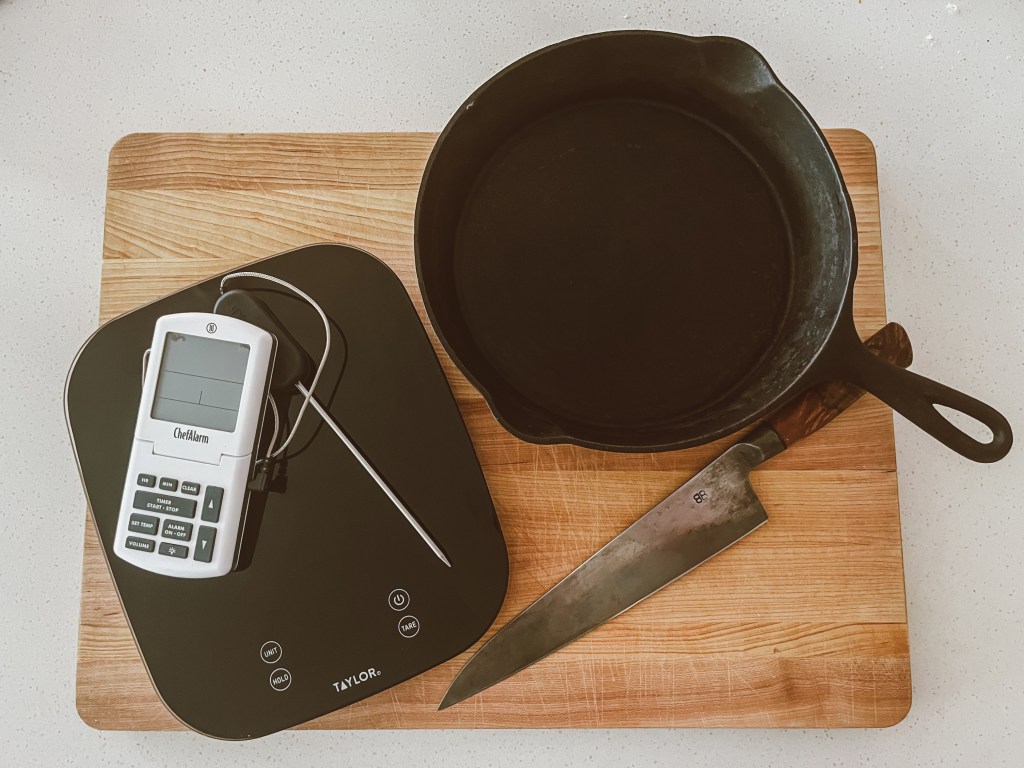
We all know the feeling. You’re trying a new recipe, you’ve got the ingredients ready, but your tools are letting you down. Maybe your dull knife is making chopping a chore, or your cheap skillet is creating stuck on messes. My goal for this blog is to help you become a better, happier cook at home. That starts with getting the right tools. I’m talking about simple, high-impact items that will make you feel like you instantly leveled up. If you’ve ever wished your kitchen was more functional, this list is for you.
Proper Knives
You don’t have to go out and buy the most expensive knife set at your local Williams Sonoma. Instead, put as many knives in your hand as possible to see what feels most comfortable to you. Go to your local kitchen store and just hold them like you would if you were chopping vegetables. Start with a good quality chef’s knife. When I say good quality, I mean one that will hold an edge well so you don’t have to sharpen it every week (note: honing with a honing steel and sharpening are two different things). This is the workhorse of the kitchen. You’ll find that cutting vegetables and slicing meats is much easier with a high quality knife. After you find a chef’s knife that you love, you can start piecing together the rest of your set (slicer, boning, paring, petty). We’ll go into this in more detail at a later date.
Good Pans
Stainless steel, cast iron, and carbon steel! Put your nonstick and aluminum pans where they belong…in the trash. Cast iron cookware has been around for over 2,000 years, while modern nonstick has been around for about 70. When cared for and used properly, cast iron, stainless, and carbon steel cookware is just as nonstick as the modern nonstick pan, without all the chemicals used to create that surface. Aluminum pans can also leach chemicals into your food and do not have the same even heat distribution and retention as cast iron and stainless steel. Like good quality knives, good pans will make cooking so much more easy and enjoyable.
Kitchen Scale
Chefs measure ingredients by weight. You should be, too. Cooking by weight is more accurate, efficient, and consistent. It removes the guesswork of using volume to measure. Look for a kitchen scale that has a high enough capacity for what you will be using it for, has the ability to switch between units (grams, ounces, pounds), and a tare function (the ability to zero out the scale while it still has something on it).
Cutting Boards
Notice it’s plural. You need at least two cutting boards: one for chicken and one for everything else. If you want one for seafood, one for beef, one for pork, one for chicken, and one for vegetables, even better! Make sure that the one you choose for chicken is dishwasher safe. Do not trust your hand-washing abilities to protect you from what raw chicken will leave behind. Hardwood cutting boards are the best but cost more. Polyethylene plastic is a good cost-friendly alternative, especially for raw meats. Glass and stone cutting boards will ruin your knives.
Meat Thermometer and Probe
Take the guesswork out of cooking meats. Using a meat thermometer is the most reliable way to ensure that meats reach the safe internal temperature needed to kill harmful bacteria. On the flip side, it will ensure that you are not overcooking, so your meats retain their moisture and tenderness. Meat thermometers help you achieve great results consistently.
These simple items, from a sharp knife to a reliable thermometer, will eliminate the frustration and guesswork from your cooking. You can find all my recommendations here.